
ADHD impulsivity is the shortening of the gap between having a thought and acting on it, so the action arrives before the weighing up does. Most people get a half second in which a plan can be reviewed and dropped. When that gap closes, the words are already out, the item is already bought, and the sensible objection turns up a moment too late to be useful.
ADHD and impulsivity get discussed as if impulsivity were an optional extra, a bolt-on to the attention problems. Impulsivity is one of the three symptom groups behind an ADHD diagnosis, described as interrupting, intruding on others, and having trouble waiting your turn. It sits alongside inattention and hyperactivity rather than being a personality trait layered on top of them.
The useful way to picture it is timing rather than strength. The brake is not missing, it is late. You can know perfectly well that the email is a bad idea and still find it sent, because knowing and stopping happen at different speeds.
The timing gap also explains why willpower advice lands so badly here. Willpower operates in the pause, and the pause is precisely what is short.
ADHD and impulsivity also vary by the hour. Impulse control in ADHD is uneven rather than absent, which is why the same person can hold their tongue through a two hour meeting and then interrupt their partner twice in the first minute at home. Fatigue, interest, stress and how much the day has already asked of you all move the line.
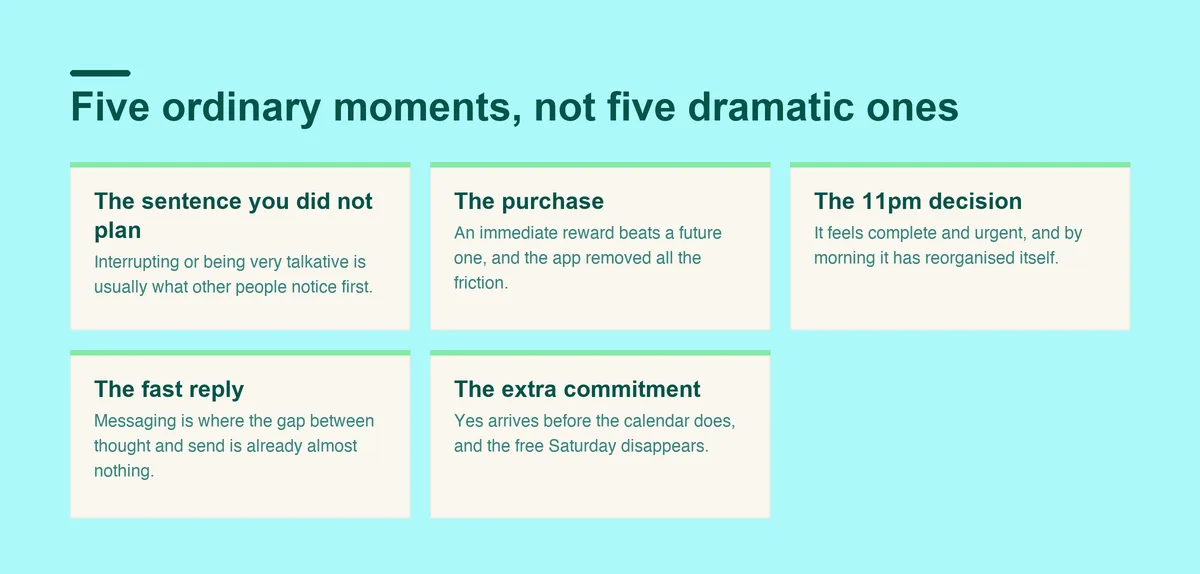
ADHD impulsivity rarely looks dramatic in an ordinary week. It looks like a series of small moments that each seem like nothing and add up to a pattern you recognise.
The pattern spreads across settings rather than sitting in one. ADHD behaviors are frequent and show up at work, at home and with the people closest to you, and that spread is part of what separates a symptom from a bad habit.
There is also a cost people rarely connect to impulsivity, which is the apologising. A week of small unplanned actions produces a low background hum of repair work, and that hum is exhausting in a way the individual moments are not.
The repair work is also what makes the pattern hard to see clearly from the inside. Each apology is filed as a separate incident with its own explanation, so the shape only appears when someone else points out that it keeps happening.
People around you tend to read the same moments as carelessness, because the visible part is the action and the invisible part is the objection that arrived a second late. That reading is worth correcting where you can, since it changes what people ask of you next.
Stopping an action is its own process, and it runs on a clock. A decision has to be evaluated before it is executed, and when execution runs ahead of evaluation there is no mechanism left to intervene.
Interest and reward also weight the scale. A task or a purchase offering something immediate wins against a consequence that is real but distant, which is why the pattern intensifies exactly when you are tired, bored or already stretched.
None of this makes the action involuntary. A short window is still a window, and it means anything that widens it works better than anything demanding more control inside it.
The distinction matters for what you try next. Advice aimed at the moment of decision assumes you get to stand in that moment, and most of the time here you do not.
Every workable answer to ADHD and impulsivity widens the gap. Nothing that works here relies on catching yourself in a moment you have already lost.
Doot is a planning tool, and it can hold the impulse until you have looked at it again. Doot suggests rather than decides, so nothing in your day moves without you.
Psychotherapy, including behavioral and cognitive behavioral therapy, is one of the two most common ADHD treatments for adults, and impulsivity is one of the things it is often used to work on. If this pattern is costing you money, work or relationships, that is the version worth taking to a professional rather than solving with app settings.
Open Doot, park the thing you were about to do, and look at it again tomorrow when the pause has come back.
Try it free on the webarrow_forward