
The alarm went off fifty minutes ago, you have looked at your phone twice, changed your mind about breakfast, and you are now going to be late for something you fully intended to be early for. An ADHD morning routine is a short, fixed sequence you can run without deciding anything, built so it still works on the morning where nothing goes right.
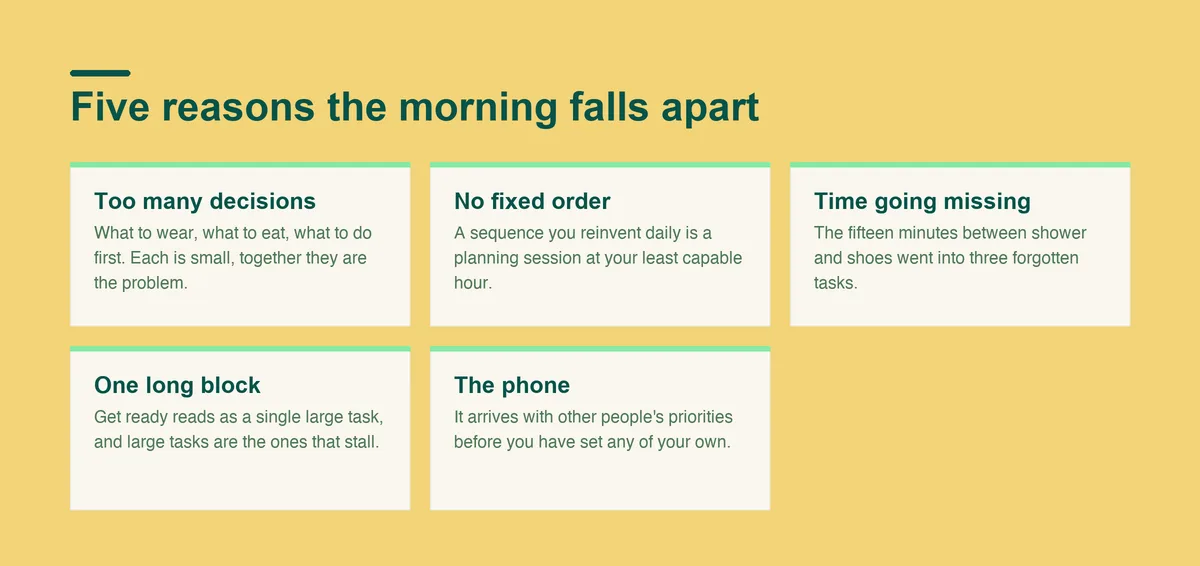
Mornings ask for a run of small decisions at the exact hour your brain is least equipped to make them. Poor time management, planning and organization are recognised adult ADHD symptoms, and a morning is nothing but those three things happening under time pressure.
The standard advice makes it worse by adding steps. A routine with journalling, a cold shower, a walk and a smoothie has nine decision points in it, and every one of them is a place to stall.
Trouble following instructions or finishing projects is also on that list, which matters here because most morning advice is written as a project. A routine that has to be completed to count will be abandoned the first time you get through only half of it.
A realistic morning routine for ADHD is short enough to finish on a bad day and boring enough that you stop negotiating with it.
Three or four fixed actions in a fixed order, taking twenty to thirty minutes, is a routine. Eight actions taking ninety minutes is an aspiration, and it will be the first thing to go the week you actually need it.
The test is not whether the routine is impressive. The test is whether you can run it on four hours of sleep, in a bad mood, with something you are dreading later that day. Anything that fails that test is a good-day routine, and good days do not need one.
Most people discover their real routine by watching what survives. Keep a loose note for a week of what you actually did each morning, in order, and the fixed sequence usually reveals itself: two or three things you never skip, and a lot of things you believed were part of the routine and have not done since Tuesday.
Building for the bad morning is the whole trick. A routine designed for the good day quietly requires a good day, which is the one thing you cannot schedule.
A short routine also changes what counts as success. If the routine is three actions and you did two, the morning worked. A routine you grade out of nine will be failed most days, and a system that reports failure every morning does not get opened again.
The other reason to keep it short is restart cost. Miss four days of a ninety minute routine and coming back feels like starting a new habit. Miss four days of a three action sequence and you simply do it tomorrow, which is why the small version survives a bad fortnight and the large one does not.
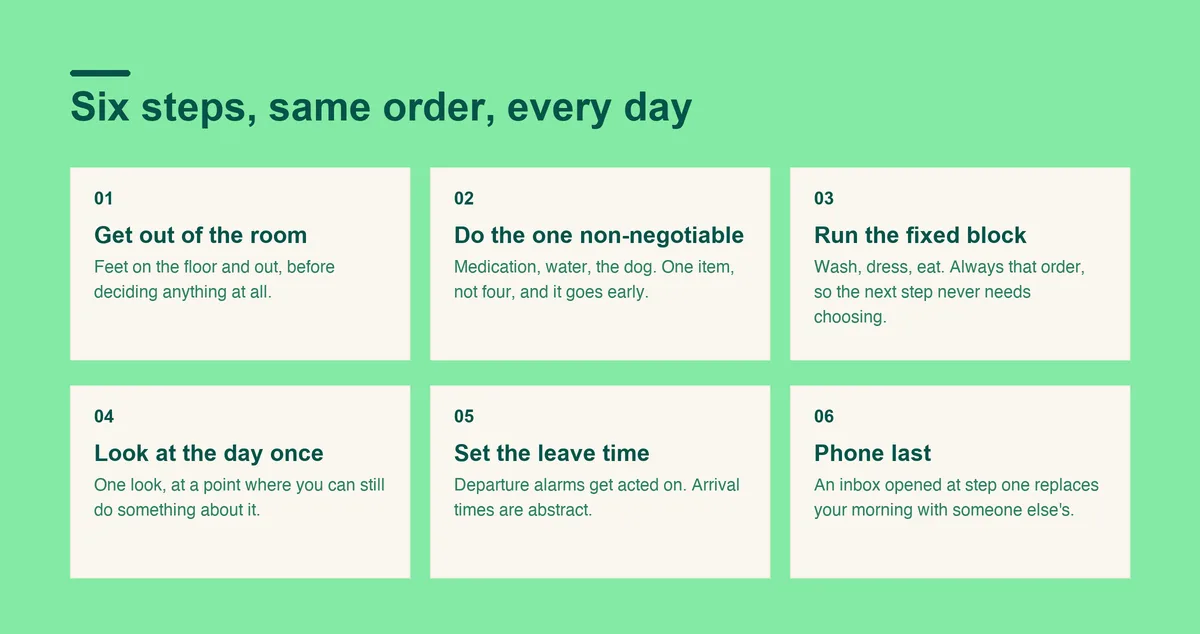
The sequence below is deliberately short. Run the same steps in the same order every day, and resist adding to it for at least two weeks.
The first action is physical and requires no judgment: feet on the floor, out of the bedroom. Deciding anything while still in bed goes badly, because the decision and the bed are competing and the bed usually wins.
Make it the same exit every morning. The point is to move the start of the day out of the place where it is easiest to stall.
Medication, water, feeding the dog, whatever is genuinely non-negotiable for you. This is the action that still happens on the worst morning of the month, so it goes early, before anything can eat the time.
Keep it to one item. A non-negotiable list with four things on it is not a non-negotiable list, it is an ordinary list with a strict name.
If you take medication in the morning, that is almost always the item. Everything else in the routine works better downstream of it, and it is the one step where missing it changes the shape of the whole day.
Wash, dress, eat. Always in that order, always the same. The order matters more than the contents, because a fixed order means the next step never needs choosing.
Decisions inside the block should have been made yesterday: clothes out, breakfast decided. A morning routine for ADHD that still contains a wardrobe decision has a hole in it.
One look at what today holds, at a point where you can still do something about it. Doot lays the day out so it can be taken in at a glance instead of read line by line, which is what makes a single look enough.
Looking four times is not diligence. The second, third and fourth look are the same anxiety asking the same question, and they cost the time the routine was supposed to save.
Work backwards from where you need to be and set an alarm for when you have to walk out of the door. Arrival times are abstract, and departure times are the thing you actually act on.
Put a second alarm ten minutes before it. The first one is information, the second one is the deadline.
The phone goes last, after the fixed block and the one look at the day. An inbox opened at step one replaces your morning with someone else's, and the routine never recovers.
Leaving the phone until last is the step people argue with, and the one that changes the most. A message read at 7am does not get answered at 7am, it gets carried through the shower, the coffee and the walk, and it quietly reorders everything you had planned before you had planned it.
If you use your phone as the alarm, put it across the room and leave it face down until you are dressed.
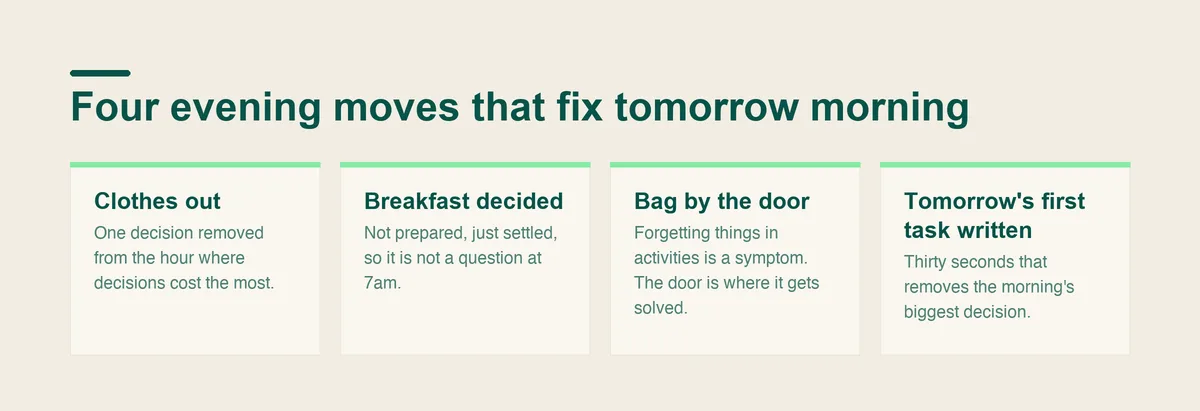
Almost every fix for a hard morning is something you do the evening before. That is the part the ADHD friendly morning routine advice tends to skip, because it is less satisfying to write about.
Writing tomorrow's first task down is where a tool earns its place. Doot takes a messy brain dump in plain English and hands back separate tasks with dates, so the thing you are meant to start is already sitting there in the morning rather than waiting to be reconstructed.
Doot also suggests rather than decides, so nothing gets rescheduled on you overnight. You wake up to your own plan rather than an algorithm's version of it.
The pattern is worth stating plainly: move every decision you can into the evening, and leave the morning to run the sequence. Evenings have slack in them. Mornings do not.
Some hard mornings are not a routine problem at all.
If you are sleeping four or five hours, no sequence fixes the next day, and the thing to work on is the night rather than the morning. If mornings are hard because you are dreading the day itself, a better routine will not touch that, and it is worth being honest about which problem you are actually solving.
ADHD symptoms interfere with daily functioning across work, home and relationships, and when the morning is one instance of a much wider pattern, the routine is a patch rather than an answer. It is never too late to seek a diagnosis, and a proper evaluation is a better use of a hard month than a fifth attempt at a new routine.
None of that means dropping the sequence. Knowing what the routine can carry is what stops you blaming yourself for the part it was never going to fix.
A useful split: the routine handles the decisions, sleep handles the capacity, and treatment handles the condition. When mornings get worse, work out which of the three actually changed before rebuilding the one that is easiest to rebuild.
Open Doot, write tomorrow's first task tonight, and wake up to a day that is already decided.
Try it free on the webarrow_forward