ADHD overwhelm: what it is and how to get through it

ADHD overwhelm is what happens when more input arrives than your brain can rank, so everything sits at the same volume and nothing moves. It can land on an ordinary Tuesday over four small things that would each pass without comment on their own, because the trouble is the ranking rather than the size of any one item. Three emails, a text you have not answered, a bill and a load of laundry can be enough to close an afternoon down.

ADHD overwhelm

What ADHD overwhelm actually is

An ADHD brain takes in roughly the same amount of input as anyone else's. What runs differently is the quiet sorting step in between, the one that decides what is urgent, what can wait, and what is background noise. When that step is inconsistent, input arrives and stays unsorted, and an unsorted pile is much heavier than an ordered one.

The sorting problem is part of the diagnosis rather than a separate flaw. Inattention in ADHD covers difficulty staying organized, not only difficulty concentrating, which is why a tidy desk and a clear head can be equally hard to hold.

Ordinary stress usually has an edge you can point to. This often does not, which is what makes it so confusing to explain to anyone watching. Three overwhelm symptoms tend to show up together:

  • Everything reads as equally urgent. The bill, the laundry and the unanswered text all press at the same volume, so none of them wins.
  • The trigger looks too small for the reaction. The size of any single item stops predicting how hard the moment lands.
  • Effort stops converting into progress. You can spend an hour fully occupied by the pile and finish with nothing crossed off.

There is a line worth naming here. Feeling swamped in a heavy week is ordinary. Symptoms that interfere with daily functioning, across work and home and the people close to you, are something else, and worth a conversation with a doctor.
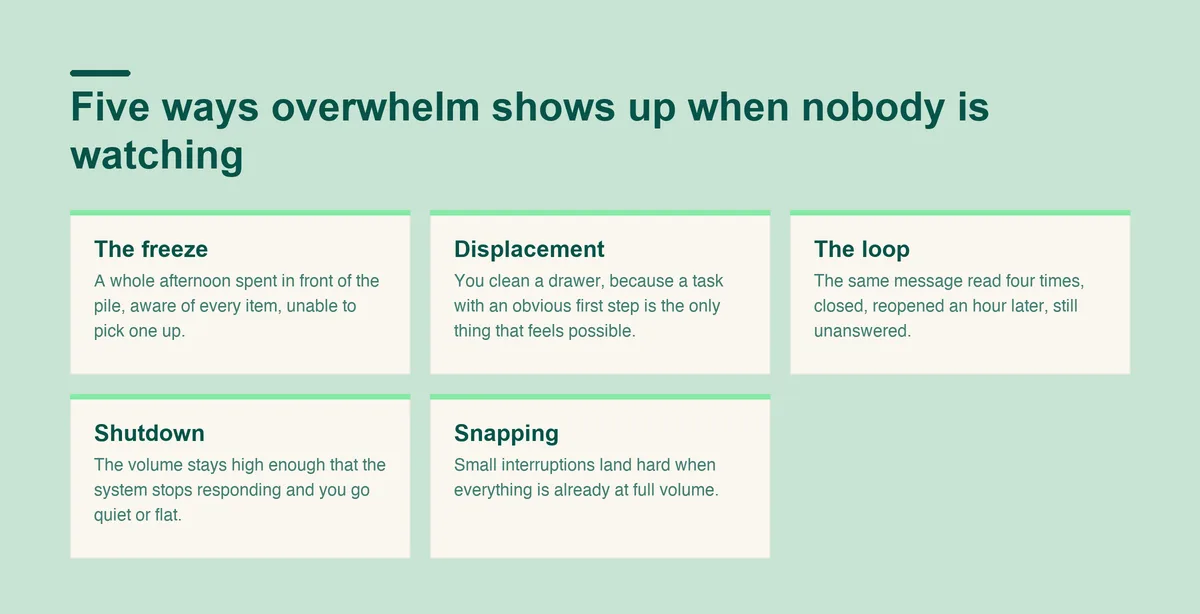
What overwhelm looks like from the inside

Five ways ADHD overwhelm shows up: freezing in front of the pile, displacement activity, looping on one message, shutting down, and snapping at interruptions

From the outside this reads as someone doing nothing. From the inside it is closer to standing in a room where four people are talking at once and being unable to choose which one to answer.

  • The freeze. ADHD overwhelm can shut down a whole afternoon while you sit in front of the pile, aware of every item on it, unable to pick one up.
  • Displacement. You clean a drawer you have not thought about in months, because a small task with an obvious first step is the only thing that feels possible.
  • The loop. You re-read the same message four times, then close it again without replying, then reopen it an hour later.
  • Physical shutdown. An ADHD overwhelm shut down is the far end of the same pattern, and people also call it an ADHD shutdown: the volume gets high enough that the system stops responding and you go quiet, or flat, or straight to sleep.
  • Snapping. Small interruptions land hard when everything is already at full volume, and the person who gets the sharp answer is usually the one nearest.

ADHD overwhelm paralysis is the state people usually mean when they say they are stuck: the pile is visible, the intention is real, and nothing moves anyway. The frustrating part is that the reaction is not proportional to the workload. A four item day can produce it and a fourteen item day can pass without it.

Overwhelm also does not stay in one place. ADHD patterns turn up across several settings at once, at work, at home and with the people you live with, and that spread is part of what separates a genuine pattern from a bad week. Someone whose Tuesday closed down over laundry is usually also the person rewriting the same two-line email on Thursday.

Why the input piles up unsorted

Ranking is a background job for most brains, done in fractions of a second and never noticed. When it does not run automatically, ranking becomes conscious work, and conscious work needs the same attention the tasks themselves are asking for.

The bind is circular. To sort the pile you need the attention that the pile is currently consuming. So the sorting gets postponed, more input arrives on top, and the next attempt starts from a bigger heap.

Three things make it worse in practice:

  • Everything lives in your head. Unwritten tasks have to be re-remembered constantly, and each re-remembering costs a little more attention.
  • Nothing has a size. An unsorted item carries no estimate, so a two minute job and a two hour job press equally hard.
  • The pile has no edge. A list you cannot see the end of reads as infinite, and an infinite list is not something anyone can start.

Disorganization is one of the recognised ways adult ADHD shows up, alongside procrastination and trouble with time. It is worth treating it the way you would treat any other symptom: not as evidence about your character, but as the thing the system around you has to account for.

What helps, in the moment and over time

In the moment, the aim is narrow: get one item out of the pile and into motion. The pile does not need solving first.

  • Empty your head onto paper. Everything, in any order, without sorting as you go. An unsorted list you can see is lighter than an unsorted list you are holding.
  • Pick anything, not the right thing. Choosing well is a second decision, and it is the one you cannot currently make.
  • Shrink it until it is almost nothing. One email, one plate, one phone call. Ten seconds of a task counts as beginning it.
  • Move first if none of that works. Standing up and walking to another room changes the input, which is sometimes enough to break the freeze.

Over time, the fix is structural. If the sorting step is the thing that stalls, then the system around you has to do more of it.

  • One capture place, always. Anything that lives in two places is really living in neither.
  • A day you can look at. Doot puts the whole day in one view you take in at a glance, which moves the ranking off your attention and onto the screen.
  • Suggestions you stay in charge of. Doot suggests rather than decides, and nothing moves in your day without you.

Structure helps with the load. It does not answer the question underneath it. If overwhelm is arriving most weeks and costing you work or relationships, a proper evaluation is the next step, and it is never too late to go looking for one.

ADHD overwhelm questions, answered

How do you deal with ADHD overwhelm? add
Get everything out of your head and onto one visible list, then pick a single item and shrink it until starting takes ten seconds. Sorting the whole pile is the work that stalls, so skip it in the moment and do it later, once something is moving again.
What are the signs of ADHD overwhelm? add
Everything feeling equally urgent, a trigger that looks far too small for the reaction, and effort that stops converting into progress. It often ends in either freezing in front of the pile or doing something unrelated and easy instead.
Is ADHD overwhelm the same as an ADHD shutdown? add
An ADHD shutdown is usually the far end of the same pattern rather than a separate event. Overwhelm is the input arriving faster than it can be ranked, and the shutdown is what happens when the volume stays high long enough that the system stops responding at all.
Why does overwhelm happen over such small things? add
Because the size of each item is not what causes it. Four small things arriving at once with no order attached can be harder than one large task with a clear first step, since the difficulty sits in ranking them rather than in doing any one of them.
Can a planner help with ADHD overwhelm? add
A planner helps with the part that is structural, which is where the pile lives and whether you can see it. Doot costs USD 8.99 a month, or USD 49.99 once for lifetime access, and the web app has a free plan, so the sorting can be tested before anything is paid for.

Sources

The pile is not going to sort itself, and you should not have to do it in your head.

The AI daily planner for messy minds. Brain dump in plain English and get back a day you can actually look at. Open Doot and put the whole mess somewhere you can see it.

Try it free on the webarrow_forward