
The link between ADHD and physical activity is a real but modest one: exercise appears to help with attention and self control for a while after you do it, and it is not a treatment for the condition. The distinction gets lost in most of what is written on the subject, usually in the direction of promising far more than the evidence supports.
The research on ADHD and physical activity reports suggested effects including a reduction in core ADHD symptoms and improvements in executive function. Suggested is the operative word, and the papers themselves are careful about it in a way that headlines are not.
The strongest findings sit with acute aerobic exercise, meaning one session and the window afterwards, rather than with long-term programmes. Reviews note that very few well-designed long-term intervention studies have been done, and that findings from the ones that exist have to be interpreted with caution because of methodological shortcomings.
There is a further limit worth knowing if you are an adult reading this. The research notes that effects in adults have not been investigated sufficiently, so most of what gets quoted confidently about exercise and ADHD comes from studies in children.
Alongside that, exercise is described as a lifestyle change some adults try, sitting outside the two most common treatments rather than among them. That framing is the honest one: a useful input, not a substitute for anything.
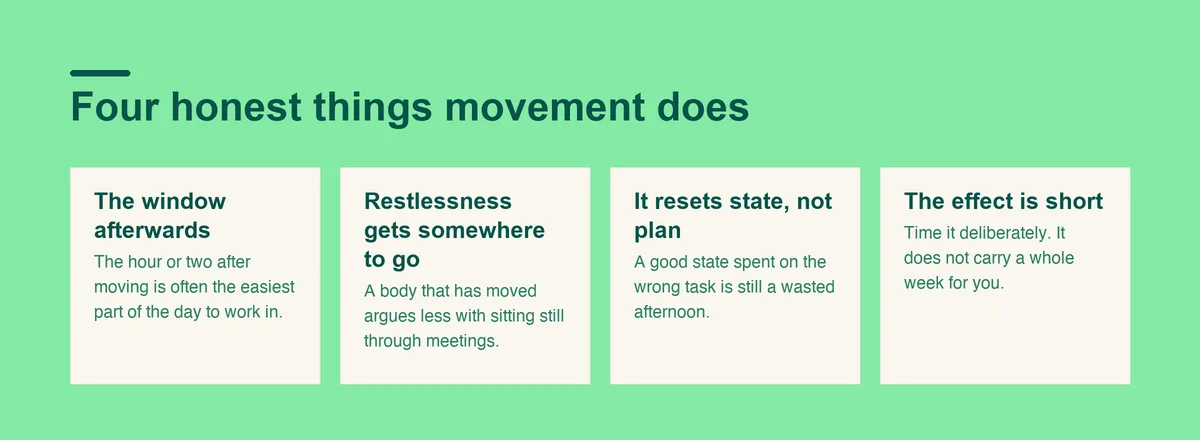
The practical version of physical activity and ADHD is smaller and more immediate than the research summaries suggest, and most of it is about the hour or two after you move. ADHD and exercise, in daily terms, means the window afterwards.
None of that requires a gym membership or a programme. A brisk walk, a flight of stairs taken twice, ten minutes of anything that raises your heart rate: the research interest is in aerobic movement, not in a particular sport.
The research on ADHD and physical activity is genuinely good news for anyone who has failed at gym routines. What gets studied is much closer to walking fast than to training.
The cost of trying is also small. Fifteen minutes and no equipment is a cheap experiment, and you will know inside a fortnight whether the window afterwards is real for you.
Run it as exactly that: an experiment, with one question. Does the hour after moving feel different enough to plan around?
ADHD and physical activity intersect because exercise temporarily changes the state of the system that attention runs on, rather than because it corrects anything underlying.
The practical mechanism most people notice is simpler than the neuroscience. Sitting down to work asks you to hold still and concentrate at the same time, which are two separate demands.
Movement beforehand takes one of those demands off the table for a while. The stillness has already been paid for, so the concentration is not competing with a body that wants to be somewhere else.
The temporary nature of the change is also why the effect fades. Nothing has been fixed, a state has been changed, and states revert.
Building a whole plan on something that lasts an hour leads to disappointment on the first day you cannot exercise. Treat it as a lever you pull on a specific afternoon.
Exercise plans fail for ADHD adults in a recognisable way: an ambitious schedule, a strong first ten days, a missed week, then nothing.
The pattern is not about motivation. It is about restart cost. The fix is to make the thing small enough that missing it does not end it.
Writing the next session down is where a planner helps. Doot takes a plain English brain dump and hands back separate tasks with dates, so the walk you meant to take tomorrow is written down rather than remembered, and it suggests rather than decides, so nothing gets moved without you.
If ADHD symptoms are interfering with daily functioning, movement is a reasonable thing to add and a poor thing to rely on. Effective treatment usually combines more than one element, and it is never too late to seek a diagnosis and talk through what the rest of that combination should be.
Open Doot, write down the fifteen minutes and the task you plan to spend the window on, and let tomorrow's version of you find both already decided.
Try it free on the webarrow_forward