
How to be productive with ADHD

ADHD productivity is the practice of arranging your day so that starting costs less, because starting is the expensive part. This is a working list of eight tactics for adults who have already tried the standard advice on how to be productive with ADHD and watched it fail by Wednesday. Each one below says what it is, who it suits, what it costs you to run, and where it falls apart, because a tactic that only works on a good day is not a system.

How to be productive with ADHD

How we picked these

Every tactic here had to clear three bars.

  • It survives a bad day. Anything that needs an hour of planning on Sunday is a tactic for the version of you that has bandwidth, and that version does not show up reliably.
  • It removes a decision rather than adding one. Poor time management, planning and organization are recognised adult ADHD symptoms, so a method whose first move is "plan your week properly" is asking the symptom to fix itself.
  • It can be abandoned and picked back up. Systems that punish a two week gap get abandoned permanently, because the restart cost grows every day you are away.

Nothing here is a treatment. ADHD symptoms interfere with daily functioning across work, home and relationships, and no arrangement of a to-do list changes that. These are tactics for the hours between.
How to be productive with ADHD: what actually works

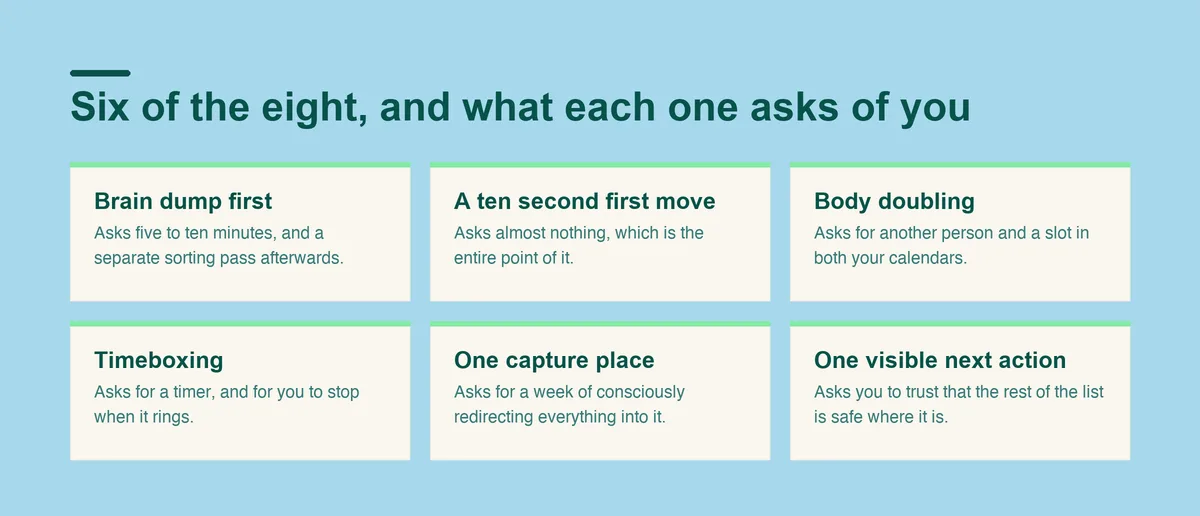
Six ADHD productivity tactics and what each asks of you: brain dump, a ten second first move, body doubling, timeboxing, one capture place, and one visible next action

Eight tactics, in rough order of how much they ask of you. Start with the cheapest one that fits the problem you actually have, since the answer to how to be productive with ADHD is rarely the most elaborate option available.

1. Brain dump before you plan anything

  • What it is. Everything in your head onto one page or one screen, unsorted, in whatever order it arrives. Sorting comes after, as a separate pass.
  • Who it suits. Anyone whose main symptom is a loud head rather than a full calendar.
  • What it asks. Five to ten minutes, and the discipline to not sort while you capture.
  • Where it falls apart. The dump becomes a graveyard if nothing ever converts it into dated tasks, and a list that only grows stops being opened.

2. Shrink the first move to ten seconds

  • What it is. The commitment is "open the document", not "write the report". You are agreeing to ten seconds of work.
  • Who it suits. People who stall at the starting line rather than in the middle.
  • What it asks. Almost nothing, which is the entire point.
  • Where it falls apart. On tasks that are genuinely long and unpleasant, ten seconds gets you in but does not keep you there.

3. Body doubling

  • What it is. Working alongside another person, in the room, on a call, or in a shared video session, each doing your own thing.
  • Who it suits. People who can work fine once started and cannot start alone.
  • What it asks. Another human being, and a scheduled slot.
  • Where it falls apart. It depends on someone else's calendar, so it is unavailable exactly when your week gets chaotic.

4. Timeboxing in small blocks

  • What it is. Twenty five to fifty minutes on a clock against one task, then a real break.
  • Who it suits. People who lose whole afternoons without noticing where they went.
  • What it asks. A timer and a willingness to stop when it rings.
  • Where it falls apart. During hyperfocus, stopping on a timer can cost more than it saves, and rigid blocks make a day of interruptions feel like a day of failures.

5. External deadlines and accountability

  • What it is. Telling one person when a thing will be done, or booking the appointment that makes the task real.
  • Who it suits. People for whom urgency, not importance, is what actually moves a task.
  • What it asks. A small amount of social exposure.
  • Where it falls apart. Manufactured deadlines stop working once your brain learns they are fake, so they need to cost something real.

6. One capture place, and only one

  • What it is. Every task lands in the same place, whether it arrives by text, in a meeting or in the shower.
  • Who it suits. Anyone currently running three apps, two notebooks and a stack of screenshots.
  • What it asks. A week of consciously redirecting things into one place.
  • Where it falls apart. The rule breaks the first time you are somewhere the tool is not, so it needs to be the tool you always have on you.

7. Reduce the day to one visible next thing

  • What it is. The full list exists, but only the next action is in front of you. Doot works this way: it shows one next action and keeps the backlog out of view.
  • Who it suits. People who freeze at a fifteen item list and can act on a one item list.
  • What it asks. Trusting that the rest of the list is safe where it is.
  • Where it falls apart. If the next action was chosen badly, you will do the wrong thing efficiently, so the list still needs a review pass.

8. A daily plan you can look at rather than read

  • What it is. The day laid out as a shape you take in at a glance, instead of a column of text you decode each time you check it.
  • Who it suits. People who read their own list four times and still cannot tell what today holds.
  • What it asks. Two minutes in the morning, or a tool that builds the view for you.
  • Where it falls apart. A plan you never revisit is decoration, so it needs one honest check partway through the day.

How they compare

Most ADHD productivity tips are sold as if the only cost is deciding to try. The real cost is what each one asks of you every time you run it, which is what decides whether it survives a bad week.

TacticBest forWhat it asks of you
Brain dumpA loud head, too many open loops5 to 10 minutes, and a separate sorting pass
Ten second first moveStalling at the startAlmost nothing
Body doublingCannot start aloneAnother person, and a scheduled slot
TimeboxingDays that disappearA timer, and stopping when it rings
External deadlinesUrgency beats importanceSome social exposure
One capture placeTasks scattered across appsA week of redirecting everything
One next actionFreezing at a long listTrusting the backlog is safe
A day you can seeRe-reading the list all dayTwo minutes, or a tool that builds it

The pattern in that right hand column is the useful part, and it is most of what anyone needs to know about how to be productive with ADHD: the tactics that survive are the ones whose running cost is close to zero. ADHD productivity hacks that ask for a weekly planning ritual fail for the same reason gym memberships do, which is that the cost arrives before the payoff and has to be paid again every week.

How to be productive with ADHD questions, answered

How do you stay productive with ADHD and depression? add
Cut the list to one thing and lower the bar for what counts as done, since depression removes the energy that ADHD tactics assume you have. Treat the combination as a medical question first: the most common treatments for adults are medication and psychotherapy such as CBT, and effective treatment usually combines more than one element.
What is the best ADHD productivity system? add
The one whose running cost you can pay on a bad day. An ADHD productivity system that needs a weekly ritual works brilliantly for three weeks and then quietly stops, so pick the cheapest arrangement that solves your actual bottleneck.
Do ADHD productivity hacks stop working after a while? add
Manufactured urgency does, because your brain learns the deadline is not real. Structural tactics such as one capture place or one visible next action hold up better, since they change what is in front of you rather than relying on a trick.
Is ADHD productivity a discipline problem? add
No. Poor time management, planning and organization are named as ways adult ADHD shows up, and the symptoms usually continue from childhood into adulthood. Someone getting professional support can also learn executive function skills directly, which is a different route than trying harder.
What does Doot cost? add
Doot costs USD 8.99 a month, or USD 49.99 once for lifetime access, and the web app has a free plan. It handles the capture and the one-next-action part rather than the doing.

Sources

Eight tactics is seven too many to start with.

Take the cheapest one on the list, run it for a week, and judge it on whether it survived your worst day rather than your best. If the bottleneck turns out to be capture and choosing, Doot handles that part.

Try it free on the webarrow_forward