
You sat down forty minutes ago with one job to do, and you have since read three articles, checked two apps and made a coffee you did not want. Focusing with ADHD without medication is the practice of building enough external structure that attention has somewhere to land, rather than waiting for it to arrive on its own.
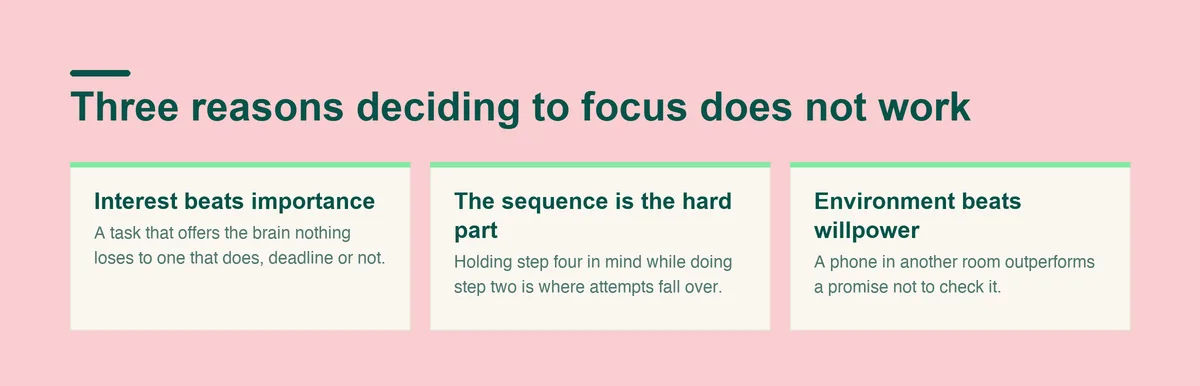
Attention in an ADHD brain follows interest and urgency more than it follows importance. That is why the tax return sits untouched while something genuinely absorbing holds you for four hours without a break.
Inattention in ADHD covers difficulty keeping on task and staying organized, which are two different problems wearing one label. You can be perfectly capable of concentrating and still unable to hold a sequence of steps in order, and the advice to "just focus" treats those as the same thing.
The practical consequence is that focus cannot be summoned by deciding to focus. It has to be arranged: the task made smaller, the interest supplied from outside, the environment stripped of the things currently winning.
Unmedicated focus is rarely the smooth, hours-long concentration people picture. It comes in usable blocks with untidy edges, and the skill is in stacking the blocks rather than extending any one of them.
Search how to focus with ADHD without medication on Reddit and the same shape comes back from hundreds of people: usable blocks, not smooth hours. A realistic good day looks like three or four solid stretches of twenty five to fifty minutes, separated by genuine breaks, with a slow patch after lunch that no amount of determination fixes. A realistic bad day is one stretch, and the work is picking which stretch to spend.
Learning how to focus with ADHD means learning your own pattern rather than copying someone else's. Most people have a window where attention is cheapest, often early, and the single highest return move is to protect that window for the work that matters most.
The tell that you are working against your pattern is effort with no output: an hour fully occupied by a task, at the end of which nothing has moved. That is a signal to change the conditions, not to try harder for a second hour.
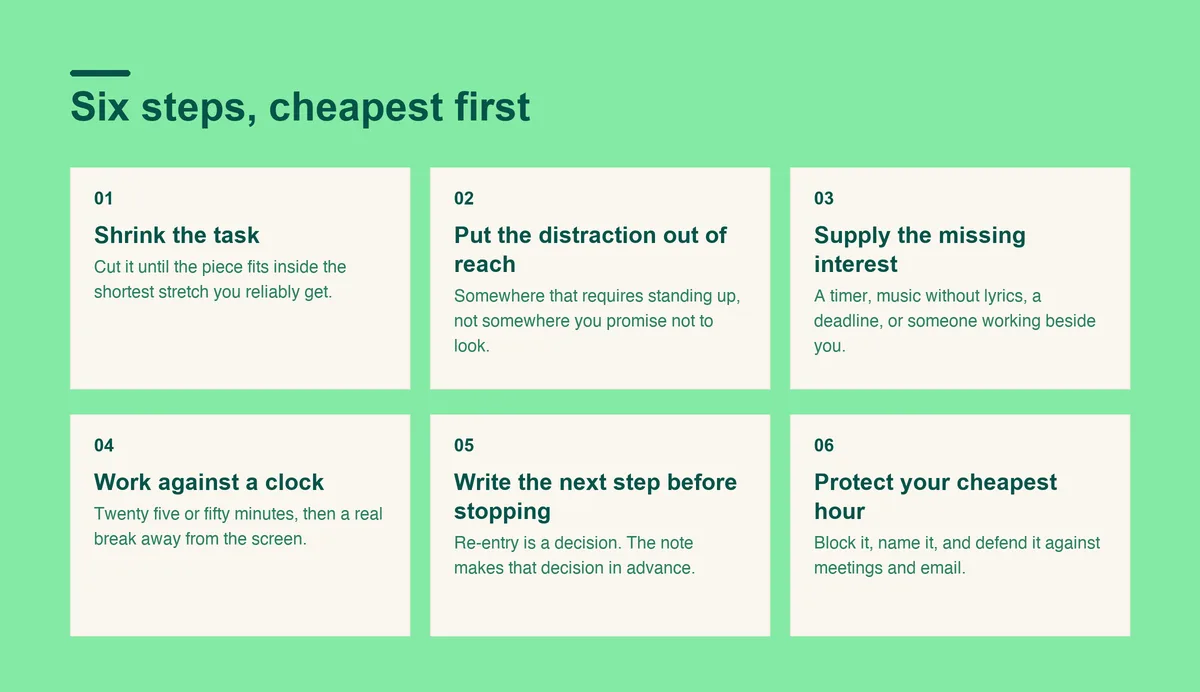
Work down this list in order. Each step is cheaper than the one after it, so stop at the first one that gets you working.
A task sized to forty minutes fails on a day that has fifteen in it. Cut it until the piece in front of you fits comfortably inside the shortest stretch you reliably get, then do only that piece.
Phone in another room, tabs closed, notifications off at the system level. Willpower spent on resisting a notification is willpower not available for the work, and the resisting happens every few minutes.
Music without lyrics, a timer running, a slightly uncomfortable deadline, or a person working beside you. Dull tasks do not become interesting, so the interest has to come from the setup around them.
Twenty five or fifty minutes against one task, then a real break away from the screen. The clock does two things: it makes the commitment finite, and it stops a good stretch turning into a four hour session you pay for tomorrow.
At the end of a stretch, note the exact next action. Returning to a task is where most of the time goes, and a written entry point removes the reconstruction work that makes coming back so expensive.
Find the hour where focus costs you least and defend it against meetings, email and everything else that wants it. Working out how to focus with ADHD without medication is mostly a scheduling problem once the tactics above are in place.
Two more that people ask about often. Exercise is described as something some adults try as a lifestyle change rather than an established treatment, so treat it as a useful input rather than a fix. Working with a coach who teaches executive function skills directly is another route, and one people underrate next to app-based advice.
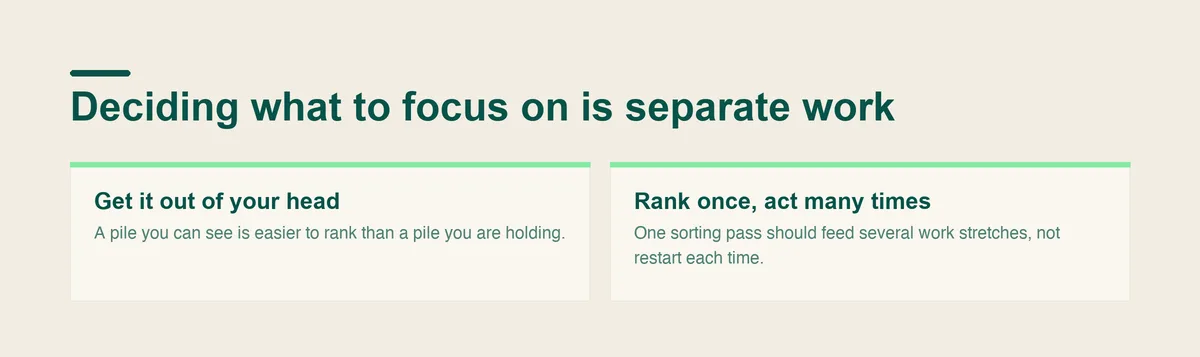
Every step above assumes you already know what you are meant to be focusing on. On most days the harder question is which of eleven half-formed things deserves the good hour, and no focus technique answers that.
Sorting the pile is separate work from doing the work, and it needs the same attention the task needs. That is why a morning can vanish into deciding, leaving the actual window spent before anything starts.
Doot was built for exactly this gap. The AI daily planner for messy minds. Brain dump in plain English and get back a day you can actually look at. You type or say the whole mess, and it comes back as separate tasks with dates, so the good hour goes to the work rather than to deciding.
Doot also suggests rather than decides, so nothing in your day moves without you. On paper, the same effect comes from dumping and sorting in two separate sittings, never in one.
There is a point where more technique stops helping, and it is worth naming plainly rather than selling around.
Psychotherapy, including behavioral and cognitive behavioral therapy, is one of the two most common ADHD treatments for adults, alongside medication. Effective treatment usually combines more than one element, which means structure, professional support and medication are not competing answers to the same question.
Everything above about how to focus with ADHD without medication is aimed at the daily cost of the condition, not at the condition itself. Choosing to go without medication is a legitimate decision, and it is yours to make with a doctor rather than with a website. What the structure above can do is lower the daily cost of a brain that runs this way. What it cannot do is treat the condition.
If focus problems are costing you work, money or relationships, that is the signal to get a proper evaluation rather than a better app. Seeking a diagnosis and treatment is worth doing at any age, and doing it does not require giving up a single tactic on this page.
Open Doot, put the eleven half-formed things somewhere you can see them, and spend your best hour on the one that matters.
Try it free on the webarrow_forward