The task has been on your list for nine days, it would take about twenty minutes, and you have done four other things today instead. Every hour you do not do it, it gets slightly heavier and slightly harder to explain to anyone, including yourself.
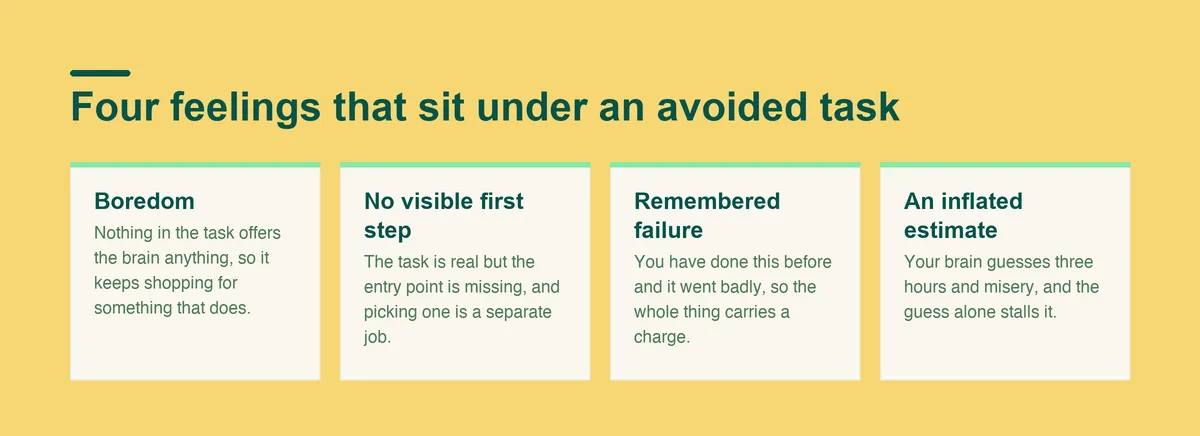
ADHD procrastination is avoidance of a feeling attached to a task, not avoidance of the work itself. That is why it targets the twenty minute job you dread and leaves the two hour job you find interesting completely untouched.
Discipline based advice assumes the block sits between knowing and doing, and that pushing harder closes the gap. The block usually sits earlier, in a moment where the task carries something uncomfortable: it is boring, or unclear, or you have already failed at it once and remember exactly how that went.
Procrastination is also named among the ways adult ADHD shows up day to day, alongside disorganization and trouble with time. Anyone working out how to stop procrastinating with ADHD is working on a symptom, not a character defect, and symptoms respond to different treatment than flaws do.
ADHD procrastination rarely looks like doing nothing. It looks like being busy at a slight angle to the thing that matters.
You reorganise a folder, answer easier emails, research the task thoroughly without starting it, or clean a kitchen that did not need cleaning. All of it is real work. None of it is the work.
The pattern has a tell: the avoided task keeps its original size in your head while everything around it gets smaller. A phone call you have avoided for a week stops being a phone call and becomes a whole category of dread.
Then the deadline arrives and the task takes forty minutes, which is the part that stings. That gap between the feared version and the real version is what makes it so hard to explain to someone who does not experience it.
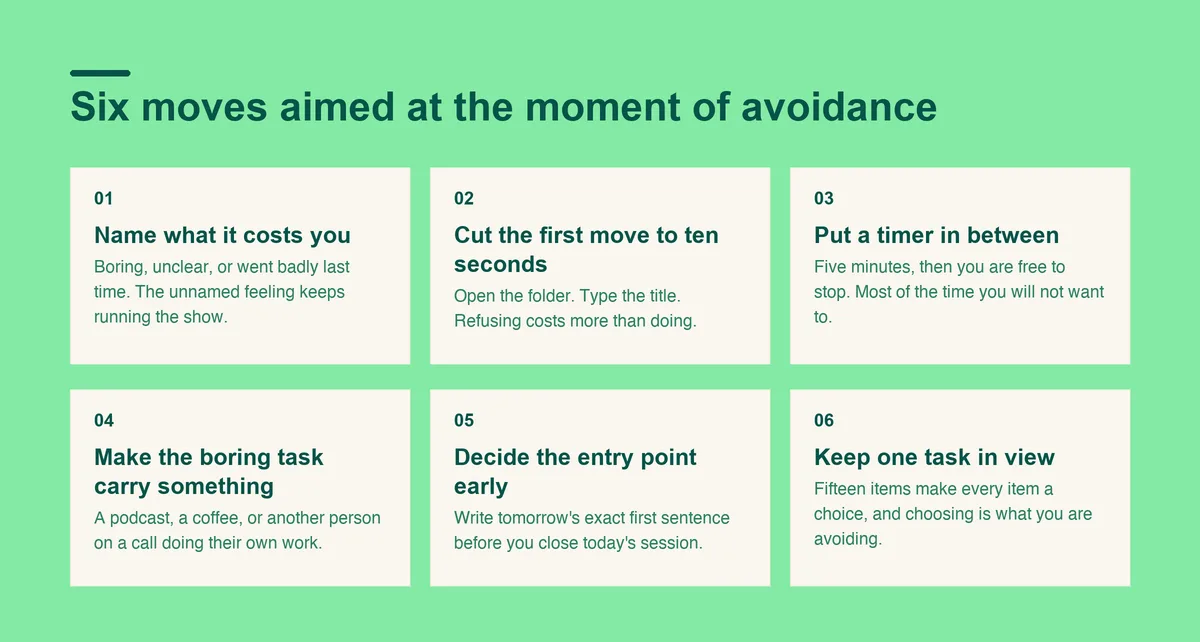
Most advice on how to stop procrastinating with ADHD aims at willpower. The moves below aim at the moment of avoidance instead. Work through them in order, and stop at the one that gets you moving.
Say the specific thing out loud: this is boring, or I do not know where to start, or I got this wrong last time. The feeling that has no name keeps running the show, and a named one usually gets smaller.
Naming it sounds soft for a first step. It is the only step that tells you which of the moves below will work, because a task avoided out of boredom needs a different fix from a task avoided out of dread.
Not "do the taxes" but "open the folder". Not "write the report" but "type the title". You are committing to ten seconds, and ten seconds is small enough that refusing it takes more effort than doing it.
Five minutes on a clock, then you are free to stop. Most of the time you will not want to, because the resistance sits almost entirely at the start and drops sharply once you are moving.
Pair it with a podcast, a coffee, a specific playlist, or another person on a call doing their own work. Learning how to not procrastinate with ADHD is often just learning to supply the interest the task refuses to supply itself.
At the end of a working session, write the exact next sentence, file or phone number for the next one. Tomorrow's version of you then finds a decision already made, which is the decision that usually stalls everything.
A fifteen item list makes every item a choice, and choosing is the thing you are currently avoiding. Doot shows you one next action and holds everything else back, so the moment of starting has nothing competing with it.
Every step above assumes you already know which task you are avoiding. Often you do not, and the pile is the problem: nine half formed obligations sitting in your head, none of them written down, all of them pressing.
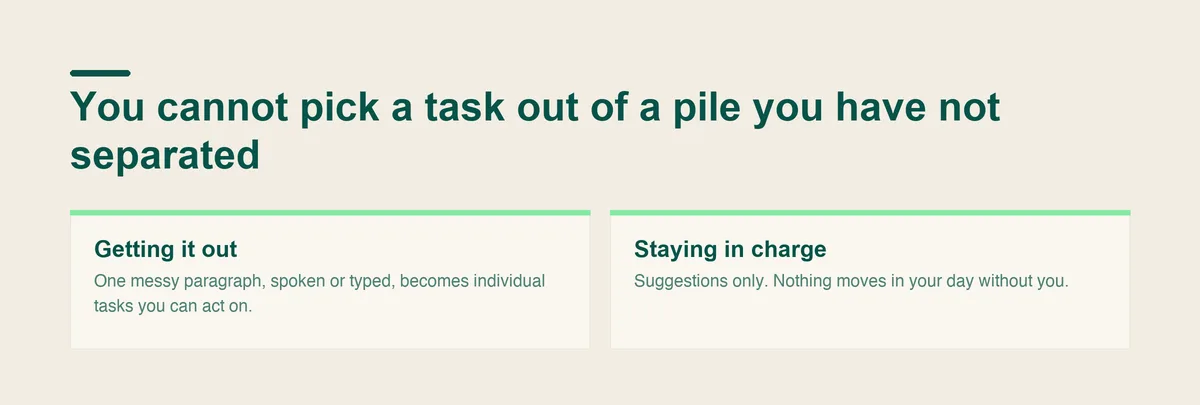
Sorting that pile is its own work, and it is the step almost every guide skips. You cannot pick the right task out of a pile you have not separated into tasks yet, and telling someone to pick faster does nothing about the sorting they have not done.
This is the gap Doot was built for. The AI daily planner for messy minds. Brain dump in plain English and get back a day you can actually look at. You type or say the whole mess in one go, and it comes back as separate tasks with dates, so the choosing happens on a screen rather than in your head.
On paper the same thing works, as long as the dump and the sort happen in two separate sittings. Doing both at once is where most manual systems quietly fall over.
Procrastination that is constant, that covers things you care about, and that is costing you work, money or relationships is worth taking to a doctor rather than to another productivity system.
ADHD and how to stop procrastinating are related questions, but only one of them has a diagnosis attached to it. The most common treatments for adults are medication and psychotherapy such as CBT, and effective treatment usually combines more than one element rather than resting on any single fix.
Seeking a diagnosis is worth doing at any age, and getting one does not mean giving up the practical moves above. It means you stop asking them to do a job they were never going to do alone.
Open Doot, dump the task you have been circling for nine days, and let it come back as something with an actual first step.
Try it free on the webarrow_forward