ADHD organization is any arrangement of your space and your lists that removes decisions and memory from an ordinary day. Organization for ADHD is a maintenance problem rather than a setup problem. Almost anyone can build a good system on a motivated Sunday, and the only question that matters is what it costs to run on an ordinary Wednesday, which is what this list is sorted by.
Eight systems, each judged on upkeep rather than on how good it looks the day you build it.
One more filter, which rules out most of what gets published on this topic: the system has to work without anyone watching. Advice built around accountability partners, shared spreadsheets or a monthly review with someone else is really a social arrangement with an organizing theme, and it ends when the other person gets busy.
ADHD symptoms interfere with daily functioning, so treat all of this as reducing daily cost rather than fixing anything. Some adults also work with a coach who teaches executive function skills directly, which does something an arrangement of boxes cannot.
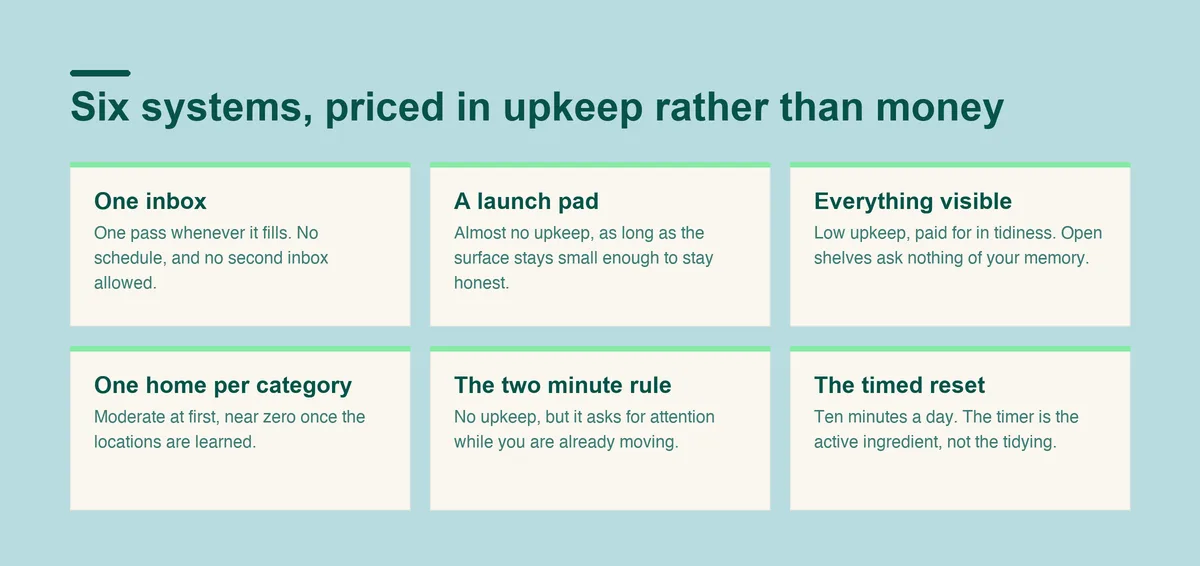
Ordered by running cost, cheapest first. Take one. Taking three at once is how people end up with none.
Two of the eight are worth doing whatever else you pick, because everything else leans on them: one inbox, and one look a day at what you are carrying. The other six are optional arrangements around those two.
The reason a single inbox works is that it converts a search problem into a sorting problem. Searching costs attention you do not have in the moment you need the thing, and it costs it under time pressure, usually while you are already late. Sorting can happen whenever you have ten quiet minutes, which is a completely different demand.
The inbox also does something subtler. A tray with eleven things in it is a visible, finite amount of work. The same eleven things scattered across a kitchen, a car and a coat pocket feel infinite, and the feeling drives avoidance far more than the actual work does.
A launch pad works on the same logic as a fixed morning sequence: it moves a decision out of the four minutes where there is no room for one. Anything you decide at the door, you decide badly. The four minutes before leaving is the single most expensive stretch of decision-making in the day, and every item you can pre-place is a decision deleted from it.
Visible storage trades one cost for another, deliberately. Cupboards look calmer and cost you the mental work of remembering what is inside them, which is exactly the work that keeps failing. Open shelves are louder and ask nothing of your memory.
The usual objection is that visible storage looks cluttered. It does. The question is whether a calmer looking room that costs you twenty small searches a week is actually the better trade, and for a lot of people it is not.
One home per category is the system most worth writing down somewhere. Households run into trouble when two people hold slightly different maps, and the fix is a short shared list of where things live rather than an argument at the point of use.
The two minute rule is doing something specific: it stops tiny tasks entering a list at all. A backlog made of forty two-minute jobs is much heavier than the forty jobs themselves, because every one of them has to be read, ranked and carried.
The rule has a natural home, which is while you are already moving. Walking through the kitchen and putting the thing away costs almost nothing. Getting up from focused work to do the same job costs the rest of the hour, which is why the rule needs a place rather than a general commitment.
The timer is the active ingredient in a reset, not the tidying. A bounded ten minutes is something you can agree to on a bad evening, and the bound is what stops the reset turning into a project that gets postponed instead of done.
Body doubling works for clear-outs for the same reason it works for tasks: the other person supplies the structure that the job itself does not. It is worth booking for the specific drawer or box that has survived three attempts, rather than for general tidying.
A digital backlog is also where organization for ADHD stops being about the house. Most people running a tidy home and a chaotic head are dealing with the second problem, and no amount of shelving touches it.
ADHD organization advice usually lists dozens of tips with no way to tell which ones you can actually afford to keep. This is the same eight, sorted by what they ask of you.
Two patterns are worth noticing in that last column. The systems that survive ask for something small and repeatable, and the ones that fail ask for judgment at the exact moment you have none left. That is why a ten minute timer beats a weekly tidy, even though the weekly tidy sounds more serious.
The other pattern is that none of this is about tidiness. Every system here exists to lower the number of decisions your day contains, and a house that looks organised while still demanding constant decisions has not solved the problem.
If you are starting from a mess and cannot face any of it, start with the inbox and the launch pad, in that order, and do nothing else for two weeks. Both are small enough to finish in an evening, both pay out immediately, and neither punishes you for ignoring them. The larger systems are much easier to add once something is already working.
And when a system does fail, the useful question is which part of the upkeep you stopped paying rather than whether you should replace the whole thing. Most abandoned systems were fine, and the ten minutes that fed them went somewhere else.
Open Doot if the full head is the harder half, and let the backlog sit somewhere other than your memory.
Try it free on the webarrow_forward