
You've read the task three times, you know exactly what the first step is, and your hands still haven't moved toward it. Task initiation is the act of actually beginning something you already mean to do, and for a lot of people it's the hardest single part of getting anything done, harder than the work itself once you're finally in motion.
Starting gets treated like a discipline problem, which is why the usual advice, make a list, set a deadline, just start, lands so badly.
The actual stall happens earlier than any of that, in the gap between deciding a task matters and physically beginning it. That gap is where several small decisions pile up at the same time, usually without you noticing any single one of them.
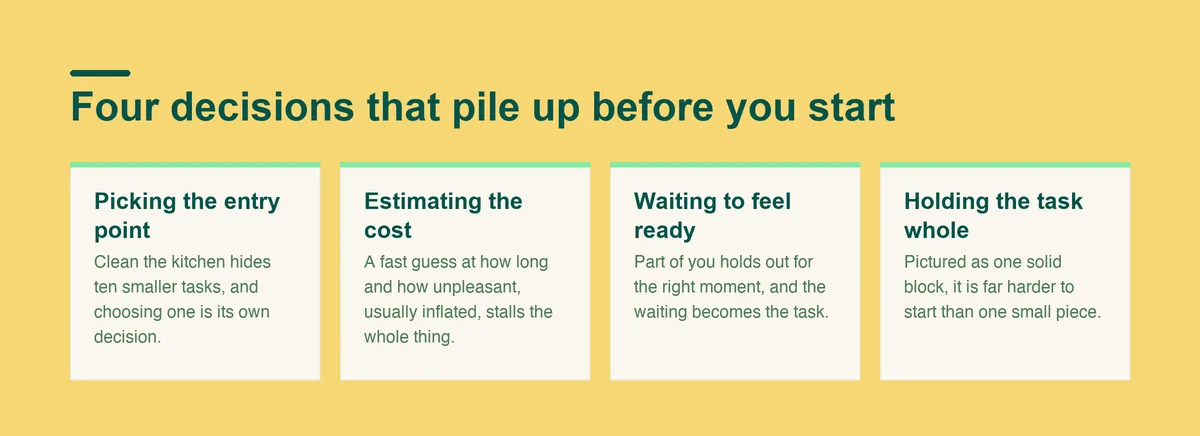
Four things happen in that gap, often all at once:
Task initiation trouble isn't laziness, and it isn't a lack of caring about the outcome. It's four separate cognitive steps compressed into a moment that looks, from the outside, like someone simply not doing the thing.
Task initiation is well documented as a piece of executive function, the set of skills that manage starting, planning and follow through, and it stalls even on tasks you actively want to do. That's usually the detail people find hardest to explain to anyone who hasn't lived it.
Knowing that the block has a mechanism is often the first thing that makes it easier to work with instead of around.
Seeing the stall as a mechanism instead of a character flaw matters more than it sounds like it should. A stall you believe is about character invites more willpower, which rarely works twice in a row.
A stall you understand as a sequence of small decisions invites a different question: which one of those decisions can be made smaller, or made in advance.
Starting trouble rarely looks the way people picture it. It isn't lying on the couch refusing to work.
The pattern is the tab open for forty minutes with nothing typed into it, the email drafted and never sent, the laundry moved from the machine to a chair, where it's easier to reach whenever you finally do fold it.
Task initiation trouble also shows up as busywork that isn't the task. You clean the desk before writing the report, or you research the best way to do something long after you already know a way that would work fine.
The tidying and the research feel productive, and they are, just not on the thing you sat down to do. They're a way of staying near the task without ever crossing into it, which is what makes this version so easy to miss from the inside.
Scrolling counts too. Fifteen minutes on your phone right when you meant to start is often the same stall in a different outfit.
A quieter version shows up too: knowing you're avoiding something while you're doing it. You can be halfway through tidying a desk, fully aware the report is the actual job, and still not able to redirect yourself toward it.
Task initiation trouble is exactly that gap between knowing and doing, and noticing it happen almost never closes it on its own, which is usually the most frustrating part for people who've already read plenty about the general idea.
Task initiation trouble also shows up as reaching for the smallest, least useful task on the list, the only one you can start.
The report stays untouched two days running while three small errands get done back to back, each one real, none of them the thing that actually needed doing. By the end of the day the errands feel like proof you weren't idle, even though the one task that mattered hasn't moved.
Task difficulty isn't really the variable here. A five minute task can produce the same stall as a two hour one, because the block sits at the starting line, not inside the work. If any of this sounds like your week, the pattern has a name, and it isn't a character flaw.
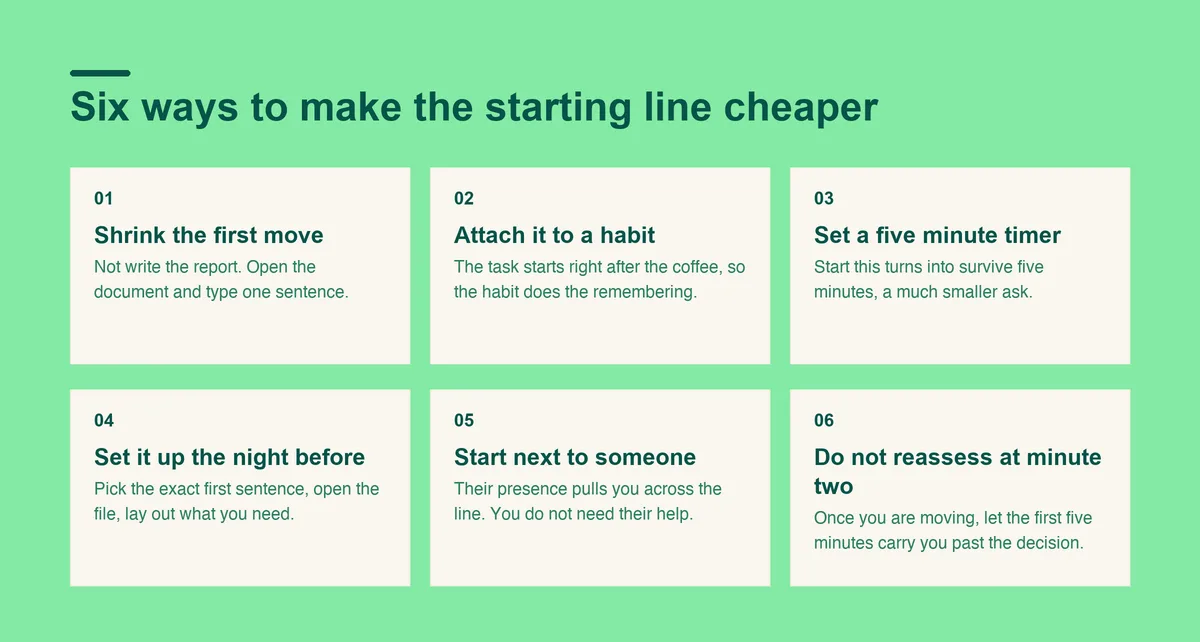
The moves below target the starting line itself. Try them in order, and keep each one small enough that skipping it feels harder than doing it.
Not "write the report," but "open the document and type one sentence." The task itself doesn't get smaller, only the piece you're committing to right now does.
A ten second commitment is much easier to start than an open ended one. Once you've done the tiny version, the next piece is usually much closer than it looked from the outside.
Shrinking the move works because your brain resists open commitments far more than it resists bounded, tiny ones. A task with no visible edge asks for an estimate of the whole thing before you've begun, and that estimate is where the stall usually starts.
Pick an existing habit, coffee, sitting down at your desk, closing your laptop lid, and decide the task starts right after it.
The habit does the remembering for you, so starting stops depending on noticing the right moment on your own. Over a couple of weeks the pairing gets automatic enough that you stop needing to decide at all.
Commit to five minutes on the clock. Five minutes is short enough that almost anyone can agree to it, and it turns "start this thing" into "survive five minutes," which is a much smaller ask of your brain.
When the timer ends you're free to stop, and most of the time you won't want to, because the hardest part is already behind you.
Choose the exact first sentence, the exact first folder, the exact first phone number, the night before or the moment you finish the task ahead of it.
Deciding in advance means there's no decision left to make at the actual moment of starting, which is usually where the stall lives. Write the entry point down somewhere you'll see it, so future you doesn't have to reconstruct it from memory.
Vague entry points fail for a specific reason: "start the report" still contains a hidden decision about where exactly to begin, and that hidden decision is enough to stall the whole plan.
Working alongside another person, in the same room, on a call, or in a shared virtual space, makes the first move noticeably easier.
You don't need their help with the task. Their presence alone is often enough to pull you across the starting line, the same way it's easier to get moving in a gym full of people than an empty one.
Lay out the clothes, open the file, put the form on the counter, the night before or first thing in the morning.
Friction that feels trivial once you're moving is often exactly what stops you before you've started, because it adds one more tiny decision to a moment that already has too many.
Once you're in motion, don't stop to reassess whether this was the right task or the right moment. Momentum handles what motivation couldn't, and the version of you five minutes in almost never wants to have stopped.
Save the reassessing for tomorrow's planning.
Starting is only half the negotiation. Decide in advance what counts as a good stopping point, one page written, one email sent, five minutes on the clock, so you're not also negotiating an exit while you're already mid task.
Knowing there's a clean place to stop makes it noticeably easier to agree to start in the first place, because the commitment has an edge on both sides.
None of these eight moves need to happen together, and most days one or two will do the job on their own.
Pick whichever removes the specific decision that's stalling you today, since the gap rarely looks identical twice, and the step you skipped last time is usually worth trying first.
Every step above assumes you already know what the first task is. Most days, you don't.
You have a pile of half formed obligations in your head, a text from your sister, the thing your manager mentioned, the appointment you keep meaning to book, and none of it is sorted into anything you could actually start.
Sorting that pile is its own piece of work, and it's the step almost every list of starting tips skips entirely.
Turning "a bunch of stuff I'm carrying around" into "one specific next action" takes real cognitive effort, the same kind that's already stretched thin when starting is hard in the first place. Skip this step and every move above still has to compete with a head full of unsorted noise.
Advice to "just pick the smallest task" falls flat for the same reason. Picking assumes the tasks are already separated out and named, and most of the time the pile hasn't gotten that far yet.
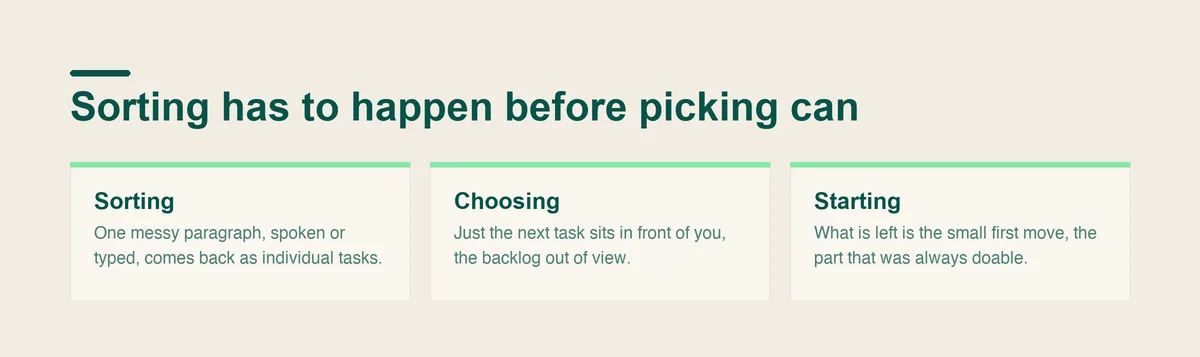
The sorting has to happen before the picking can, and telling someone to pick faster does nothing about the sorting they haven't done.
Doot was built for exactly this part. The AI daily planner for messy minds. Brain dump in plain English and get back a day you can actually look at.
You type or speak the whole pile out in one go, however messy or incomplete, and it comes back as separated, sortable tasks instead of one block you'd still have to process yourself.
If you'd rather stay off an app, do the same thing on paper: dump everything first, sort it into single next actions second, and never try to do both passes in the same sitting.
Combining them is where most manual systems stall. If you want the sorting handled for you,Doot does that part automatically, so the first thing you see is already something you can start.
The eight moves above help when the trouble is starting something you already intend to do and roughly know how to do.
The same moves don't fix a schedule that's genuinely too full. If nothing gets started because there's more work than hours in the day, the honest fix is dropping commitments, not finding a cleverer way to begin them.
The same moves also won't touch a stall that comes from grief, burnout, depression, or a task you're avoiding because it's actually the wrong task in disguise.
Sometimes the block is information: the task doesn't belong to you, the deadline is wrong, or the whole project needs a different shape before it needs a first step.
A few signs point toward a capacity problem:
When that's the pattern, the fix is subtraction.
Starting trouble that's new, getting worse, or affecting your work or your relationships is worth raising with a doctor. That's especially true if it comes bundled with a change in sleep, mood, or concentration that isn't explained by anything else going on.
The moves above can sit alongside that conversation. They aren't a substitute for it, and no app or checklist is either.
Open Doot, get everything out of your head in one go, and come back to a single next task instead of a pile you still have to organize.
Try it free on the webarrow_forward