Time blindness is the inability to accurately sense how much time has passed or how much is left, so you're either shocked that it's 6pm already or convinced a task will take twenty minutes when it takes two hours. It's not about not owning a watch. People with time blindness check the clock constantly and still show up late, because the number on the clock and the felt sense of time don't talk to each other.
If that sounds less like a quirk and more like a daily tax, you're not imagining it. Time blindness is one of the most common and least talked about traits of ADHD, and it shows up in autism, depression, and plenty of people with no diagnosis at all. This page covers what it actually looks like, a quick way to check if it applies to you, and the fixes that work because they stop asking your brain to do the one thing it can't do reliably: feel time pass.
Most people have a rough internal clock. They can guess that twenty minutes have passed within a few minutes either way, and they can feel a deadline getting closer the way you feel a wall getting closer when you walk toward it. Time blindness is what happens when that internal clock is unreliable or missing. Time either doesn't register at all (you look up and an hour is gone) or it registers as one flat, undifferentiated blob (tomorrow and next month feel about the same amount of "not now").
Researchers call this weak time perception, and it's now considered a core feature of ADHD rather than a side effect of poor planning. Later almost never comes on time, because "later" doesn't have a felt distance attached to it. It's just a word.
This is different from being disorganized. Organized people can still have time blindness. They'll build the perfect color-coded schedule and then blow through three of its blocks because the schedule lives on paper, not in their sense of the day.
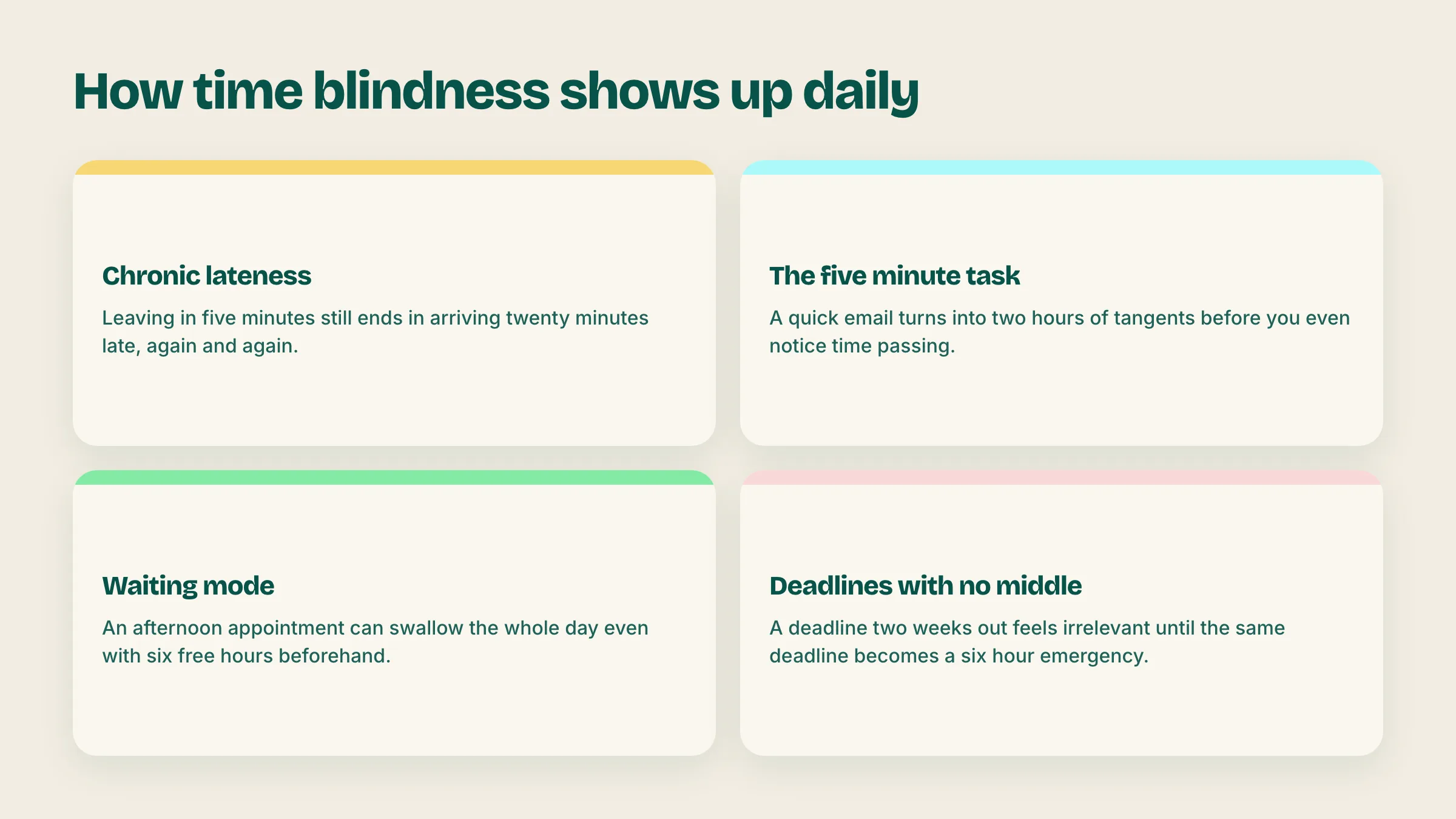
It rarely shows up as one dramatic thing. It shows up as a pattern of small, repeated moments:
If several of these feel uncomfortably familiar, you're not bad at time management in the way that phrase usually implies. You're missing the sense that time management assumes everyone has.
There's no single clinical "time blindness test" the way there's a blood test for iron levels, but a few questions will tell you fast whether this is worth addressing:
Answering yes to three or more is a strong sign of time blindness. This isn't a substitute for an assessment. If it's affecting your work, relationships, or how you feel about yourself, a doctor or therapist who works with ADHD can give you an actual evaluation and rule in or out what's driving it.
Time blindness isn't a willpower problem. It's downstream of executive function, the brain's set of management skills that includes working memory, planning, and time perception. When those systems are taxed, which is common in ADHD, the sense of time is often the first thing to go, because tracking elapsed time silently in the background is exactly the kind of task executive function handles for most people without them noticing.
If this angle is new to you, our executive dysfunction guide goes deeper into what executive function actually covers and why "just focus harder" doesn't fix any of it. Time blindness and adhd paralysis also travel together often: losing your sense of time can be exactly what tips a task from "doable" into "so overwhelming I can't start," because you can no longer tell if there's enough time left to bother.
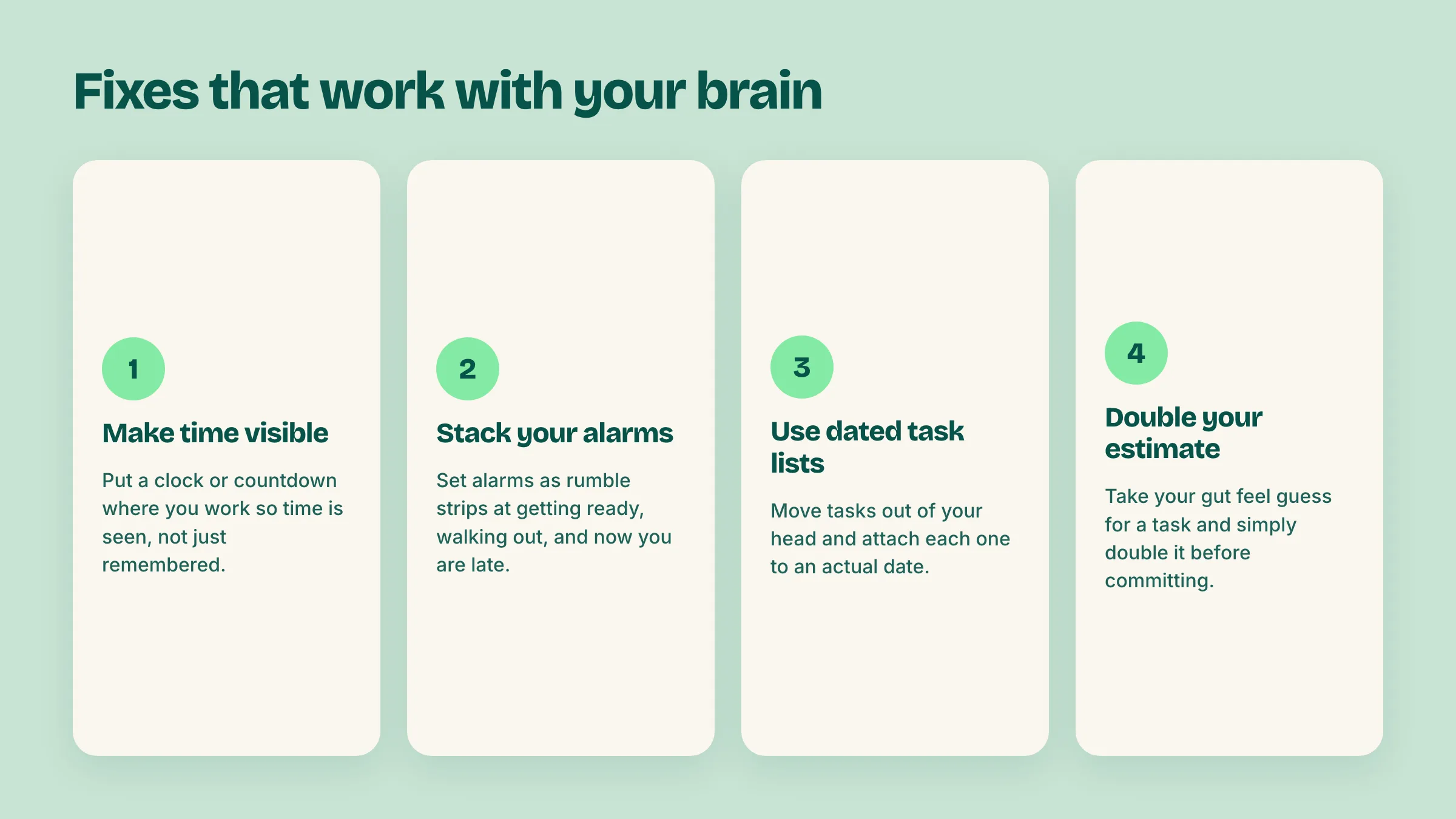
The advice "just be more aware of time" fails because awareness isn't the missing piece, sensing is. These fixes work because they replace the internal sense you don't have with an external one you can actually use.
Put time outside your head, not inside it. A wall clock in every room you work in, a visible countdown on your desk, a calendar you glance at without opening an app. The goal is time you can see without having to remember to check, because remembering to check is the exact skill that's unreliable here.
Use alarms as rumble strips, not micromanagers. One alarm that says "leave now" is useless if it's the only signal. Set a stack: one at "start getting ready," one at "you should be walking out," one at "you're now late." Rumble strips don't drive the car for you, they just make it impossible to drift without noticing. Alarms should work the same way: frequent, low-effort nudges rather than one high-stakes reminder you're supposed to catch perfectly.
Replace mental queues with dated task lists. If your plan for today lives only in your head as a rough sense of "stuff I should get to," it will lose every fight against whatever feels urgent in the moment. A written, dated list turns "sometime today" into a specific slot, which gives your day actual shape instead of one long undifferentiated stretch. This is also why a proper brain dump habit helps so much with time blindness specifically: once tasks are out of your head and attached to real dates, you're no longer relying on a felt sense of "I should get to that soon" to make anything happen.
Time-box instead of open-ending. Instead of "work on the report," try "work on the report until the timer hits zero, then stop and reassess." A visible timer converts an abstract chunk of time into something you can watch shrink, which is closer to how people without time blindness experience a work session anyway.
Build in a buffer you don't touch. If you consistently underestimate by roughly 2x (a very common ratio), don't try to estimate better. Take your gut estimate and double it before you commit to anyone else. It feels wrong every time and is right almost every time.
Look for adhd time management tools that show time, don't just track it. Traditional to-do apps assume you'll remember to check them and can accurately judge how long each item takes. Look for tools built around visible time (timers, calendars, and dated lists you see without digging) rather than ones that just store a list and trust you to manage the clock yourself.
Doot won't give you a working internal clock, nothing can. What it does is take the two things time blindness sabotages most, remembering what's on your plate and knowing when things are due, and puts them outside your head where they can't quietly slip. Brain dump a messy list of everything on your mind and Doot turns it into dated tasks automatically: "sometime this week" becomes an actual day, "later" becomes a date you can see. You stop relying on a felt sense of urgency to know what needs attention, because the list already tells you.
Turn your mental to-do pile into a dated task list Doot keeps visible for you. Try Doot and give your sense of time something to lean on.
Try it free on the webarrow_forward