ADHD and dopamine is the pairing behind one of the most repeated explanations for ADHD: the idea that an ADHD brain simply runs short on dopamine, and that the shortage explains everything from restlessness to trouble finishing what you start. The research on ADHD and dopamine does exist, and it does connect the two, just not in the tidy, single-cause way that explanation suggests.
Dopamine is one of the brain's core signaling chemicals, doing far more than manage mood. A few of its main jobs:
ADHD sits on the other side of the pairing. The National Institute of Mental Health describes it as a developmental condition defined by inattention, hyperactivity and impulsivity that stick around well past childhood for a lot of people.
Pairing a reward-and-attention chemical with a condition defined by trouble sustaining attention makes a dopamine explanation feel obvious.
Researchers have tested that idea for decades. ADHD's symptoms have long been suspected of tracing back to shifts in how the brain handles dopamine, though that suspicion remains a theory rather than a proven mechanism.
ADHD and dopamine, in other words, are linked. How, how much and in which direction is still being worked out, and no single study has closed that question yet.
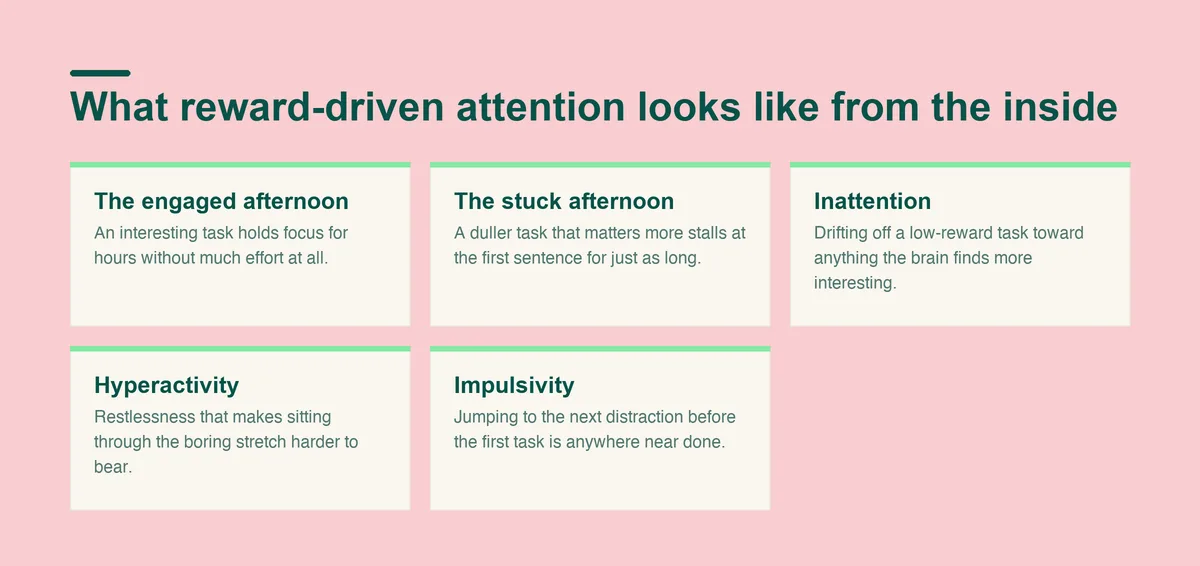
The dopamine research shows up in daily life as a pattern many people with ADHD recognize before they ever hear the science: attention that swings hard depending on what the brain's reward circuitry finds interesting, rather than on what actually matters most.
Two different afternoons can come from the exact same kind of work:
The three symptoms behind an ADHD diagnosis tend to show up in that same reward-driven pattern:
Medication and age change the picture too:
The reward system here is not broken. The reward system just routes differently, which is why tools built around that routing tend to help more than tools that simply ask for more discipline.
Stimulant medication gets in the way of the pumps that would otherwise sweep dopamine back inside the nerve cell after it fires. That leaves more dopamine lingering where the next cell's receptors can pick it up.
The mechanism itself is well documented. What is still open is whether the problem it is compensating for is too little dopamine, too much, or something about timing rather than a simple amount.
The dopamine transporter is a small, physical thing: a protein sitting on the outside of a nerve cell, built to pull dopamine back in once it has carried a signal across to the next cell. Stimulant medication slows that pull, which is a narrower claim than "fixing a chemical shortage."
What the evidence does and does not support:
On the open question of direction, research pulls two ways:
Both readings come from the same body of research, which is a fair description of where the science currently sits: unsettled, not resolved. Mapping your own case onto either theory is a conversation for a doctor who knows your history, not something a page about ADHD and dopamine can settle from the outside.
The unsettled science does not change what actually helps day to day. ADHD is not something treatment erases outright, though consistent treatment can meaningfully ease symptoms and help someone function better, according to the National Institute of Mental Health.
A doctor's evaluation is also where a conversation about medication belongs. Of the options available, stimulants are prescribed the most for ADHD, and studies back them up as strongly effective for a lot of the people who try them. Whether one is right for you comes down to you and a doctor working it out together, not a call this page can make.
Practical steps that do not depend on resolving the open questions above:
Doot takes a narrower angle on the same problem. The AI daily planner for messy minds. Brain dump in plain English and get back a day you can actually look at.
Doot turns a single tangled paragraph, whether you type it or say it out loud, into separate tasks in one pass. Doot leans toward suggesting instead of deciding, so nothing on your schedule moves without you saying so.
Doot's suggest-first design matters most for a brain that already has an evaluation, a medication plan, or neither in place: a tool that quietly rearranges your day removes exactly the kind of control that makes a plan worth opening again tomorrow.
Open Doot, brain dump what's actually on your mind, and get back tasks you can act on instead of a page of theory.
Try it free on the webarrow_forward