
This list is for anyone with ADHD who is choosing between offers, weighing a career change, or already in a role that fights the way their brain works, and it looks at what each kind of work actually asks of you rather than what the title promises.
Jobs for people with ADHD are roles whose daily rhythm works with attention that runs in bursts, not against it: quick feedback, real variety, and room to move. ADHD itself is a developmental condition that brings lasting patterns of distraction, restlessness and impulse, which is why the shape of the work matters more than its title.
No government agency, medical body or career counselor certifies which occupations suit ADHD. The picks below are judgment, built from the traits ADHD involves and the protections and accommodations already in place at work.
The Job Accommodation Network notes that people with ADHD may show some of the traits it lists as workplace limitations, but rarely all of them. So the picks below aren't a "safe" list. Each one is a role whose ordinary shape removes some of the friction that shows up most often: long stretches with no feedback, work that only exists in your head until a deadline, or a schedule with no natural break points.
Each pick covers what the work involves day to day, who tends to do well in it, and where it gets hard even for people who like it.
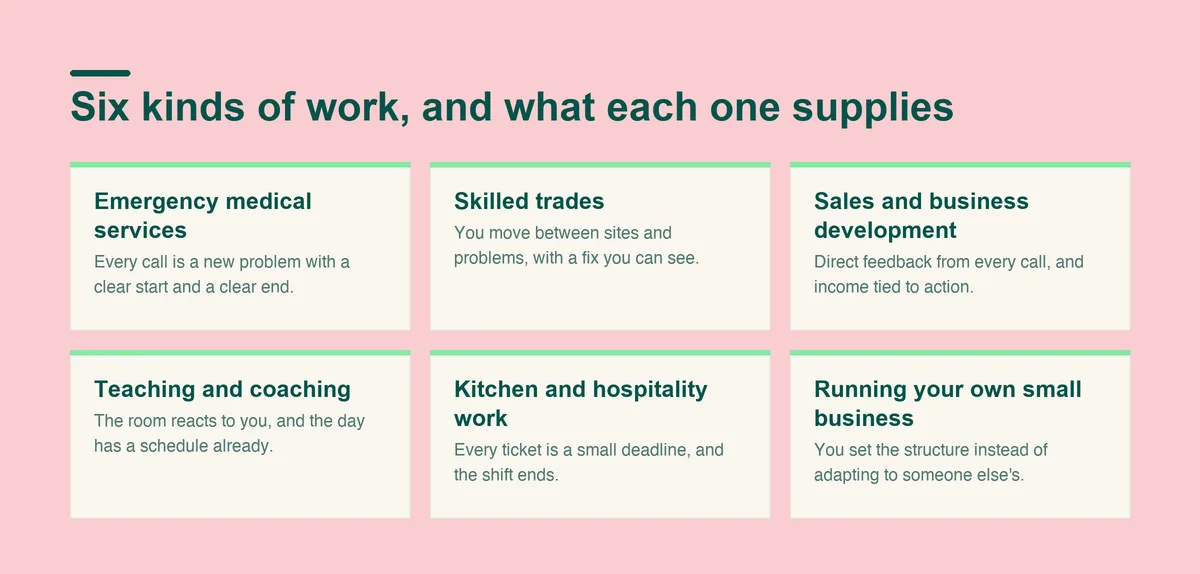
The roles below keep coming up when the criteria above are applied honestly: fast feedback, real movement, and structure already built into the day. Several also show up on "worst jobs for ADHD" lists, because the same trait that makes a job energizing on a good day can make it exhausting on a bad one. Read the part where it gets hard before you decide anything.
EMT and paramedic work is built around the call, not the clock. You show up, assess, act and hand off, and then the next call is a different problem entirely. The pace suits a mind that struggles to sit with one task for hours, and the stakes supply urgency you don't have to manufacture yourself.
Who it suits: people who focus best under real pressure and go stale during long, quiet stretches.
Where it gets hard: the paperwork after the call is the opposite of the call itself, slow and detail heavy, and it's often where the day actually falls behind. A tool that turns a rushed voice note into a written task list, like doot, closes some of that gap, though it doesn't replace the reporting itself.
Electricians, plumbers and HVAC techs move between sites and problems constantly, and the work is hands on enough that attention has somewhere to go besides the clock. Every job is a puzzle with a physical answer, and you get to see the fix work, or not, right away.
Who it suits: people who think through their hands and lose focus fast at a desk.
Where it gets hard: running your own schedule, chasing invoices and quoting jobs is a second job on top of the trade itself, and it has no fixed shape to lean on. If you already track callbacks and quotes in Todoist, the guide to running Todoist with ADHD covers keeping that list from outgrowing what you can act on.
Field sales and business development roles hand you a new conversation every call, a visible pipeline, and commission that rewards action over hours logged at a desk. The job has built in feedback: you know within days, sometimes minutes, whether something worked.
Who it suits: people who read a room quickly and lose energy when nothing is happening.
Where it gets hard: every deal that isn't closed today needs a follow up, and the follow up list is exactly the kind of pile that swallows a distracted afternoon. That's the exact problem doot exists to catch: a rushed paragraph about who to call back becomes dated tasks instead of a mental note that quietly expires.
A classroom or a practice field resets every hour, with a different group, a different problem, and an audience that reacts to you immediately. The structure of the day is already built before you arrive, which removes one of the harder parts of most jobs: deciding what to do next.
Who it suits: people who like being watched and respond well to a room that talks back.
Where it gets hard: the grading, planning and admin that happen after the room empties are the opposite of teaching itself, solitary and open ended. If keeping the week visible matters more than any single day, the guide to a planner for ADHD covers setting one up around that gap.
A dinner rush has its own built in urgency: tickets come in, food goes out, and there's no ambiguity about what happens next. The pace is set for you, which suits a mind that runs better against a real deadline than an open ended one.
Who it suits: people who like pressure with a clear end point and don't mind being on their feet all shift.
Where it gets hard: the pace that makes service exciting also makes it physically draining, and burnout in kitchens is common for reasons that have nothing to do with ADHD specifically. The quiet stretches between services, where prep and admin live, are usually where the day gets away from you instead.
A story has a beginning, a deadline and an end, usually inside days rather than months, and that shape suits attention that runs out before a long project does. Every assignment is different enough that the job rarely repeats itself two days running.
Who it suits: people who work in bursts and want proof of finished work often, not once a quarter.
Where it gets hard: chasing sources, following up on interviews and tracking half finished pitches is unstructured in a way the actual writing isn't, and it's easy to lose a promising story in the gap between the idea and the first call.
Sessions run in short blocks with a client in front of you, real time feedback, and visible progress you can point to over weeks rather than guess at. The structure of the day is set by the schedule, not by you deciding what to do next.
Who it suits: people who focus well one on one and go flat working alone with no one to respond to.
Where it gets hard: building and keeping a full client list is a sales job wrapped around a fitness job. The ADHD timer that keeps a session honest doesn't cover the admin between clients, which is where trainers usually lose the business side of the work.
Owning the business means owning the structure too: what gets done when, in what order, and by what standard. For some people that's the whole appeal, because no one else's system has to fit you if you're the one setting it.
Who it suits: people who already fight generic systems and do better inventing their own.
Where it gets hard: the freedom that makes this appealing is also the absence of a built in schedule, and a business with no external deadline can drift for weeks before you notice. Running your own business is the job with the least built-in structure on this list, and the hardest to recommend without reservations.
Lined up next to each other, the best jobs for people with ADHD each solve a different problem rather than compete for the same one. Find the row that matches your actual bottleneck instead of the one that sounds most appealing on a good day.
If a task only exists in your head until it's overdue, emergency services, journalism and sales supply an outside deadline you didn't have to set yourself. If the problem is sitting still, the trades, kitchen work and teaching keep you moving most of the day. If other people's systems have never fit, running your own business hands you the structure to build.
ADHD jobs are not a category where one answer fits everyone. The honest test is the part each block above calls "where it gets hard": if that part sounds manageable on your worst week, the job is probably a fair bet.
Open Doot for the messy follow ups, the callbacks and the admin that no job description mentions, and turn them into a list you can actually work from.
Try it free on the webarrow_forward